Landmark Border Breakthrough Assam-Nagaland Tripartite Oil Pact Reopened After Three Decades to Fuel Northeast’s Energy Future
 Rohan Editor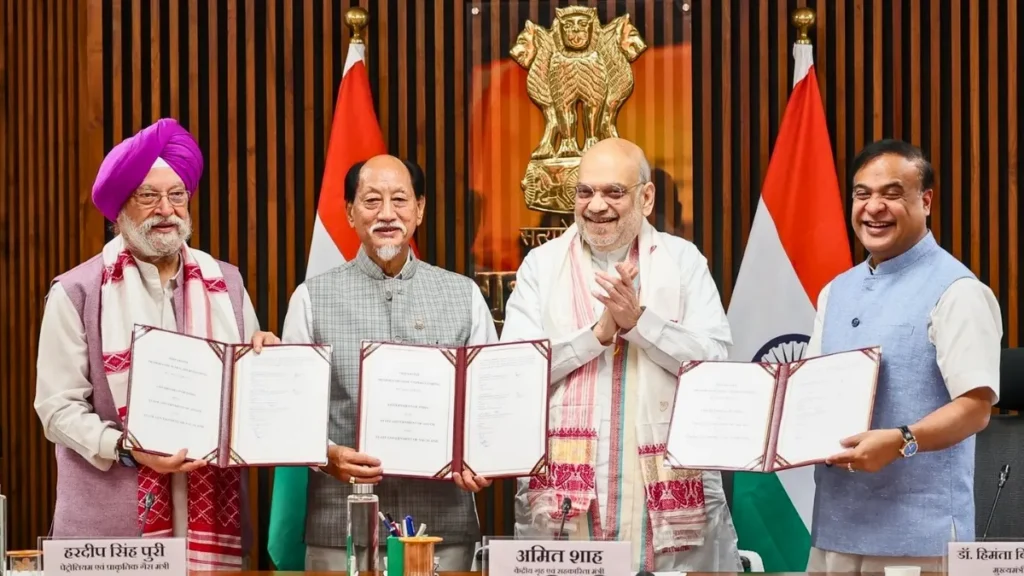
In one of the most consequential economic developments for Northeast India in recent history, the Union Government has signed a historic tripartite Memorandum of Understanding (MoU) with the state governments of Assam and Nagaland. Enacted in New Delhi in the presence of Union Home Minister Amit Shah and Union Petroleum Minister Hardeep Singh Puri, the landmark agreement establishes a formal, coordinated framework to resume long-stalled crude oil and natural gas exploration along the resource-rich and heavily contested inter-state boundary. Upstream petroleum operations in the Disputed Area Belt (DAB) had been completely suspended since the mid-1990s due to volatile border friction, recurring territorial claims, and political uncertainty. By prioritizing pragmatic economic development over unresolved territorial disputes, this pact effectively converts a historical conflict zone into a potential corridor of regional synergy, cooperative federalism, and massive industrial investment.
The structural and economic implications of the newly signed agreement are extensive, covering six designated oil and gas fields spanning more than 1,000 square kilometers of prospective hydrocarbon-bearing territory. Under the financial terms of the framework, Assam and Nagaland have agreed to a balanced 50:50 revenue-sharing model for all resources extracted from the identified border zones. Currently, the local extraction capacity hovers at a minor 1,000 to 1,500 barrels per day; however, federal officials project that this collaborative breakthrough could increase domestic production capacity by more than tenfold, generating immense value and stimulating severe downstream development across petrochemicals and city gas distribution networks. Given that India relies on foreign sources for over 88% of its crude oil needs—making the national economy highly vulnerable to international supply shocks and maritime disruptions—unlocking the untapped reserves of the Assam-Arakan Basin is a critical step toward reducing import dependence and reinforcing India’s long-term energy security objectives.
About The Author