India and Australia Strengthen Strategic Partnership with New Defence Declaration During PM Modi’s Visit
 anuprova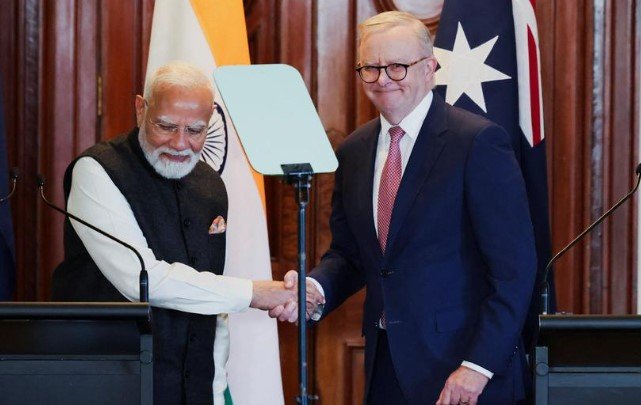
India and Australia have unveiled a new defence declaration aimed at deepening strategic cooperation in the Indo-Pacific during Prime Minister Narendra Modi’s official visit to Australia. The agreement reflects the two countries’ shared commitment to promoting a free, open, and inclusive Indo-Pacific region while enhancing collaboration in defence, maritime security, technology, and regional stability. The announcement marks another step in the growing Comprehensive Strategic Partnership between the two nations, which has expanded significantly in recent years.
The new declaration is expected to strengthen cooperation between the armed forces of both countries through increased military exercises, intelligence sharing, defence technology collaboration, and capacity-building initiatives. Both leaders also reaffirmed their commitment to maintaining peace, security, and adherence to international law, particularly in the Indo-Pacific, a region that has gained increasing geopolitical importance. The discussions also covered counterterrorism, cyber security, critical minerals, clean energy, and resilient supply chains.
Beyond defence, India and Australia explored opportunities to expand bilateral trade, investment, education, and people-to-people ties. The two sides emphasized the importance of strengthening economic cooperation and supporting innovation across emerging sectors such as renewable energy, digital technology, and advanced manufacturing. The leaders also reiterated their support for closer collaboration through regional and multilateral forums, including the Quad, to address shared global and regional challenges.
Analysts believe the latest defence declaration further reinforces the strategic alignment between India and Australia amid evolving geopolitical dynamics in the Indo-Pacific. The agreement is expected to enhance interoperability between the two countries’ defence forces while contributing to regional security and stability. As both nations continue to deepen their partnership, the new framework is likely to serve as a foundation for broader cooperation across defence, economic, and technological sectors in the years ahead.
About The Author